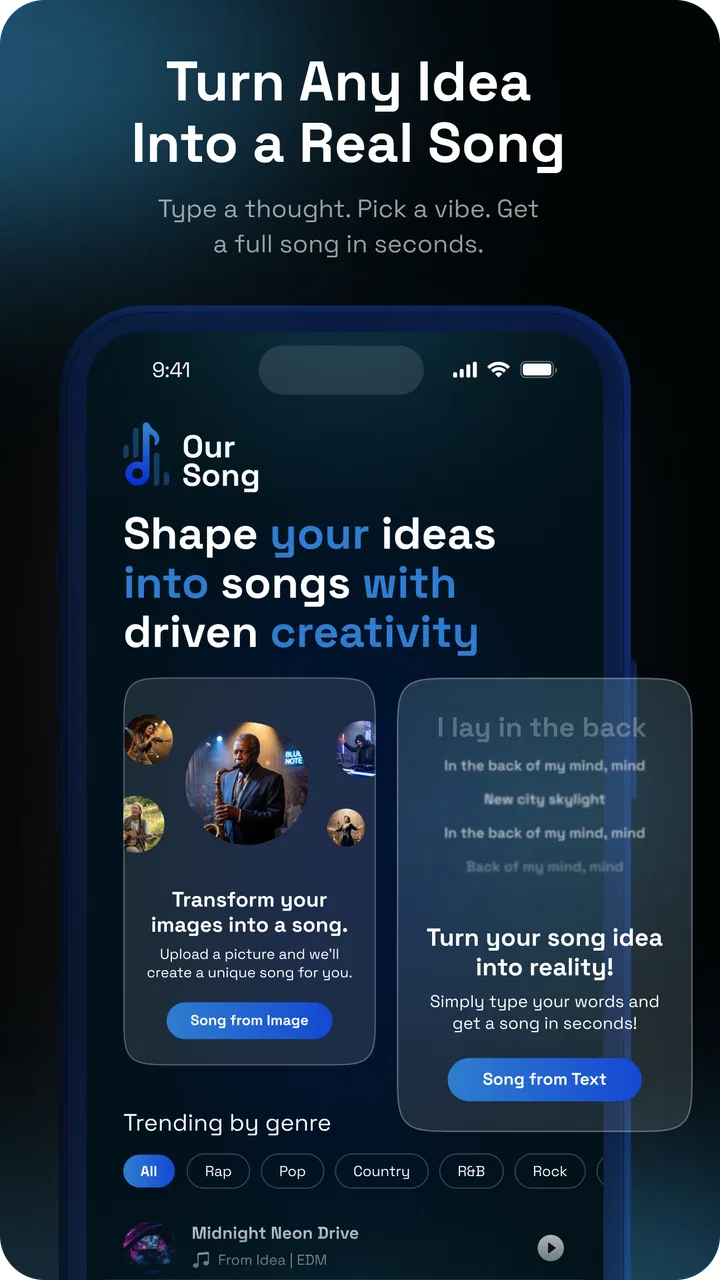
OurSongs: Custom Song Maker
- 4.7
- Rating
- 500.00K
- Installs
- Free
- Price

 Analysis by App-foxy
Some apps are built for constant listening, while others are meant to mark a particular feeling. OurSong belongs to the second group. It is a free Music & Audio app from Innovtiv, presented as a way to give personal moments a musical identity. I found that idea more interesting than a standard streaming catalog because it changes the question from “What should I play?” to “What do I want this moment to feel like?”
That distinction matters. If you want a huge library, playlists, artist discovery, or familiar radio-style listening, this is not the obvious replacement for a mainstream music service. If you want something more personal and emotionally focused, however, it has a clear reason to exist. My overall impression is that it works best as a companion for memories, relationships, celebrations, and private rituals rather than as the only audio app on your phone.
How OurSong fits into everyday listening
The app’s store summary, “OurSong: Because Some Feelings Deserve Their Own Soundtrack,” gives away its central purpose without explaining every practical detail. I approached it as a tool for connecting music with experiences. That makes it feel closer to a personal soundtrack notebook than a conventional player. The appeal is not simply hearing a song; it is assigning emotional meaning to the act of listening.
You May Also Like

 Blood Strike: 2.5 Anniversary
Blood Strike’s Loadouts Turn Every Drop Into a Tactical Gamble
A close look at Blood Strike’s custom loadouts: how fast access to signature weapons reshapes its battle royale rhythm, rewards preparation, and narrows the gap between fights.

 Pandora - Music & Podcasts
Pandora’s Music Is Easy to Start, but Harder to Recover
Pandora’s strength is its low-effort path from a seed to a station. Its weak spot is how much confidence it asks you to place in connection, setup, and quiet recovery.

 8 Ball Pool
 Is Built on Rivalries, Rematches, and Routine
A close look at the rivalries, rematches, shared routines, and unanswered safety questions that turn a quick pool match into a persistent mobile community.

 Samsung Music
’s Quiet Strength Is Playing What You Already Own
Its reach comes less from spectacle than from dependable access to a personal library. That simplicity is both the app’s strongest retention engine and its ceiling.

 AccuWeather: Weather Radar
AccuWeather Review: A Quick, Clear Forecast for Everyday Decisions
For everyday plans, the best forecast is the one you can understand quickly. AccuWeather makes rain timing, radar, and local conditions easy to act on, with a few trade-offs.

 Hill Climb Racing
Why Hill Climb Racing Still Turns Crashes Into One More Run
A tiny car, a bumpy hill and one more upgrade: Hill Climb Racing keeps resurfacing because its simple chaos makes every near-miss feel personal.
More From Our News Desk
View All News


That can be useful in several situations. You might want a musical backdrop for a relationship, a private collection for a family milestone, or a small set of songs attached to a period of change. You could also use the idea more casually: one track for a first date, another for a trip, and another for the evening you finally finished a difficult project. The value comes from the connection you create, not from the app pretending to know your life.
I also like that the concept encourages intention. Streaming apps are excellent at removing friction, but that convenience can make listening feel disposable. A focused app such as this invites you to pause and decide why a particular piece matters. That extra step is the strongest part of the experience, even though it may be unnecessary for someone who only wants background sound.
OurSong is listed for Everyone, so its concept is broad enough for different ages and types of listeners. Still, an age rating should not be confused with a promise that every person will enjoy it. The app is most suitable for people who enjoy attaching stories to music. A user who prefers technical controls, audio customization, or endless recommendations may find the emotional framing less useful.
What the free offer means in practice
The app is free to download and use, which makes trying the basic experience a low-risk decision. That is important here because the concept is personal: you may understand its appeal immediately, or you may discover that you prefer ordinary playlists. Free access gives you room to decide through use rather than committing before you know whether the approach fits your habits.
There are also in-app purchases priced at $9.99 per item. I would treat that as a separate value question rather than assuming the paid option is automatically necessary. The free entry point is the part that can be evaluated without spending money; a paid item should make sense only if it adds something you personally consider worth that amount. Since purchases are individual items, I would read the exact wording shown inside the app before buying and avoid treating the price as a subscription or as unlimited access.
This distinction is easy to overlook. “Free” can mean the app costs nothing to install, not that every possible element is included at no charge. My advice is to begin with the free experience, decide whether you are actually returning to it, and only then consider a purchase. If your use is occasional, the free access may already be enough. If the app becomes part of a meaningful routine, a single paid item could feel reasonable, but that depends on what it unlocks and how often you use it.
The current version is 1.0.6, and the app requires Android 8.0 or later. That makes device compatibility an important first check for anyone using an older phone or tablet. On a supported device, I would still keep expectations measured: an early version can be appealing and useful while also feeling less mature than a long-established music platform. The right way to judge it is by whether its specific purpose works for you, not by expecting the breadth of a large streaming service.
Where the app creates real value
The most convincing use case is a shared emotional reference. Imagine two people building a small collection around their relationship. Instead of sending isolated tracks through a messaging app and losing them in a conversation, they can treat the music as a deliberate record of moments. The practical benefit is not necessarily more songs; it is a stronger sense of continuity between them.
A similar workflow could help with a personal timeline. I would create a compact set rather than trying to record every song I heard during a month. For example, I might choose one track that represents a new job, one connected to a difficult commute, and one that reminds me of the first weekend when the new routine felt normal. Limiting the selection makes each choice carry more weight and prevents the collection from becoming another unorganized playlist.
There is a useful trade-off here: the app’s emotional focus rewards curation, but curation takes time. If you want to press play and let an algorithm decide everything, the usual streaming alternative is better. If you enjoy choosing deliberately, OurSong’s narrower purpose may feel more satisfying than a massive catalog with thousands of ignored playlists.
Another practical idea is to use it before an event rather than during one. A wedding, birthday, road trip, or anniversary can generate a lot of rushed decisions. Preparing a meaningful soundtrack in advance gives you a chance to test the mood and remove songs that sound good individually but do not belong together. The app’s concept is particularly well suited to this kind of preparation because it asks you to think about the story behind the selection.
Small habits that make the experience better
My first recommendation is to start with a theme that is narrow enough to finish. “Songs for my whole life” is too broad and may become a chore. “The music from our first month together” or “the songs that helped me through this move” gives the collection a clear boundary. This is a simple distinction, but it changes the app from an empty container into a manageable project.
My second tip is to avoid adding a song just because it is objectively good. A soundtrack built from impressive tracks can still feel emotionally flat if none of them belongs to your experience. I would choose the song that brings back a place, person, conversation, or physical sensation, even if it is not the most polished choice. That is where a personal app can offer something a generic recommendation feed cannot.
A third useful habit is to revisit a collection after some time has passed. Do not constantly edit it while the memory is still fresh. Returning later can reveal which songs still carry the feeling and which were included only because they were available at the moment. This makes the app more like an evolving memory aid than a one-time playlist builder.
I would also keep separate collections for different kinds of meaning. A shared soundtrack for a partner should not necessarily contain the same emotional material as a private set for recovery, focus, or family memories. Separating those purposes helps each collection remain understandable. It also reduces the risk of opening one soundtrack in the wrong mood and finding that its emotional associations clash.
Where the trade-offs become noticeable
The biggest limitation is built into the concept: personal meaning is work. OurSong cannot create a genuine memory for you, and no app can turn an arbitrary song into an important one through interface design alone. If you are hoping for automatic emotional discovery, you may be disappointed. The app can support the connection, but you still have to supply the story.
It is also not the best choice for listeners whose priority is breadth. A traditional music service is usually stronger for finding unfamiliar artists, following releases, building genre-based mixes, or switching quickly between moods. A dedicated player may also be preferable if you care about detailed playback controls or a highly established listening workflow. OurSong’s value is more specific, so comparing it only by catalog size would miss its purpose, while ignoring that difference would lead to the wrong purchase.
The paid structure deserves caution as well. At $9.99 per item, a purchase is significant enough to justify checking what that individual item provides. I would not buy simply because I had already spent time creating a collection. That is the sunk-cost trap: time invested does not prove that an upgrade is useful. Decide based on the benefit you can identify, the frequency of your use, and whether the free experience already meets your needs.
There is another social trade-off. A shared soundtrack can feel intimate, but not everyone expresses emotion through music. If the person you want to involve rarely saves songs or does not enjoy symbolic gestures, the app may become a one-sided project. In that situation, a simple shared playlist or a message containing one carefully chosen song might be more natural and less demanding.
Because the app is from Innovtiv and currently at version 1.0.6, I would approach it as a focused product whose long-term fit depends on how comfortably it becomes part of your routine. The current rating is a 4.9 average from around 157 ratings, and the app has passed 10K+ installs. Those figures suggest strong early interest, but they do not replace personal testing. A highly rated app can still be wrong for someone who does not want an emotionally organized music experience.
Who should try it first
I would recommend starting with OurSong if you regularly send songs to someone you care about, keep playlists tied to memories, or enjoy making small collections for specific occasions. It is especially promising for people who find ordinary music apps too impersonal but do not want a complicated journaling system. The app’s central idea gives those listeners a reason to return beyond simply searching for another track.
It may also suit someone who wants a low-pressure creative activity. Building a soundtrack can be easier than writing a long diary entry because music provides an immediate emotional shortcut. You can begin with one choice and let the meaning develop naturally. The important point is not to treat the collection as a performance for other people. Its value is strongest when the selection feels honest to you.
For families, the approach could work as a memory project, provided everyone involved actually enjoys choosing music. A parent and child might create a set around a trip, or friends might preserve the sound of a particular period in their lives. I would keep expectations realistic: the app can organize the emotional intention, but it cannot replace conversation, photographs, or the event itself.
I would skip it if you want a complete everyday music solution. Users who need constant discovery, broad listening options, or a mature all-purpose player will probably be happier with a conventional streaming app. I would also skip it if the idea of naming the feeling behind a song sounds like unnecessary effort. In that case, the app’s main strength becomes its main obstacle.
My verdict on the value
OurSong is worth trying because its free access lets you explore a distinctive idea without an upfront price. I would not describe it as a replacement for the normal music apps already on your phone. Instead, I see it as a more personal layer: a place for songs that represent something specific, especially when a normal playlist feels too casual or too easy to lose.
The paid side should be handled deliberately. A $9.99 item can be fair if it supports a collection you genuinely use and gives you a benefit you understand. It is not automatically good value merely because the app has a strong rating or because the experience feels emotionally appealing. Start free, build one focused soundtrack, return to it more than once, and then decide whether paying adds enough to justify the cost.
My final recommendation is therefore selective but positive. I would suggest OurSong to a friend who wants music to preserve a relationship, a milestone, or a private chapter of life. I would point that same friend toward a regular streaming service for discovery and everyday listening. The best setup may be both: one app for the endless supply of music, and this one for the smaller number of songs that deserve a deliberate place in your story.
After using it, the question I keep coming back to is not whether it has more music than its alternatives. It does not need to win that comparison. Its real test is whether it helps you listen with more intention. For the right person, that is a meaningful difference; for everyone else, the free option makes finding out relatively easy.
FAQs for OurSongs: Custom Song Maker
01What is OurSong and how does it work?
OurSong is a social music platform that allows users to create, share, and collaborate on music projects. It connects musicians, producers, and fans in a dynamic community. Users can upload tracks, collaborate with others, and interact with fans through comments and messages, fostering a vibrant musical ecosystem.
02Is OurSong available for both Android and iOS devices?
Yes, OurSong is available for download on both Android and iOS platforms. Users can find it on the Google Play Store for Android devices and the Apple App Store for iOS devices. This cross-platform availability ensures a wide reach, allowing users from different operating systems to connect and collaborate.
03Does OurSong offer any premium features or subscriptions?
OurSong provides a free version with basic features, but it also offers premium subscriptions. These subscriptions unlock additional features such as enhanced collaboration tools, exclusive content, and priority support. Users can choose a subscription plan that best suits their needs and budget to enhance their musical experience.
04How does OurSong ensure the security and privacy of user data?
OurSong is committed to protecting user data with robust security measures. The platform employs encryption and secure servers to safeguard personal information. Additionally, OurSong has a clear privacy policy detailing how user data is collected, used, and shared, ensuring transparency and trust among its users.
05Can I monetize my music on OurSong?
Yes, OurSong offers opportunities for artists to monetize their music. Users can sell tracks, offer exclusive content, and receive support from fans through tips and donations. The platform provides various monetization options, allowing artists to earn revenue while reaching a global audience.
Pros
- User-friendly interface for easy navigation.
- Diverse music catalog to explore and enjoy.
- Seamless social sharing features available.
- Customizable playlists for personal touch.
- Offline mode for music without internet.
Cons
- Limited free version features available.
- Occasional ads disrupt listening experience.
- Requires high storage space on device.
- Some tracks unavailable in certain regions.
- In-app purchases can be pricey.

OurSongs: Custom Song Maker
Gallery